Five-year research is completed on the topic Investigation and Development of Technology for Fuzzy Data Warehouse with the final presentation today.
You can find the project presentation at researchgate which does not include the final theses. As defined, Data warehouse is a framework that permits the strategic management access to all organizational data towards strategic decision making for a competitive advantage over competitors. It covers comprehensive technology.
When it comes to the data warehouse, it covers more technical aspects than data warehouse design as shown below.

Source: [Han J., Kamber M., 2012]
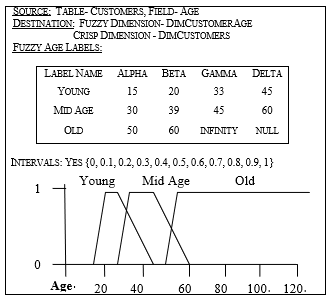
In modern days data warehouse is used to analysis but mostly crip values are used. For example, when it comes to age, we will define age groups such as Young, Middle, and Old. When the ranges are defined it will be an approximation which will lead to veracity in data.
Fuzzy logic can be used to handle the veracity aspects, so we have tried to include fuzzy logic to the data warehouse.
The following are the research objectives set at initially.
- Review current work on data warehousing, fuzzy data warehousing and fuzzy databases.
- Conduct a feasibility study to identify the domains and areas where the fuzzy data warehouse can be implemented.
- Introduce Data-Driven Technique to define Fuzzy Membership Functions for different scenarios different data warehouse technologies.
- Implement Linguistic Analysis of Data warehousing using Fuzzy Techniques.
- Design methodology for dimensions and fact tables in Fuzzy Data Warehouse.
- Design other relative features of the data warehouse to support fuzzy modelling.
- Define non-functional requirements in a fuzzy data warehouse.
- Provide Proof of concepts for fuzzy data warehouse implementation.
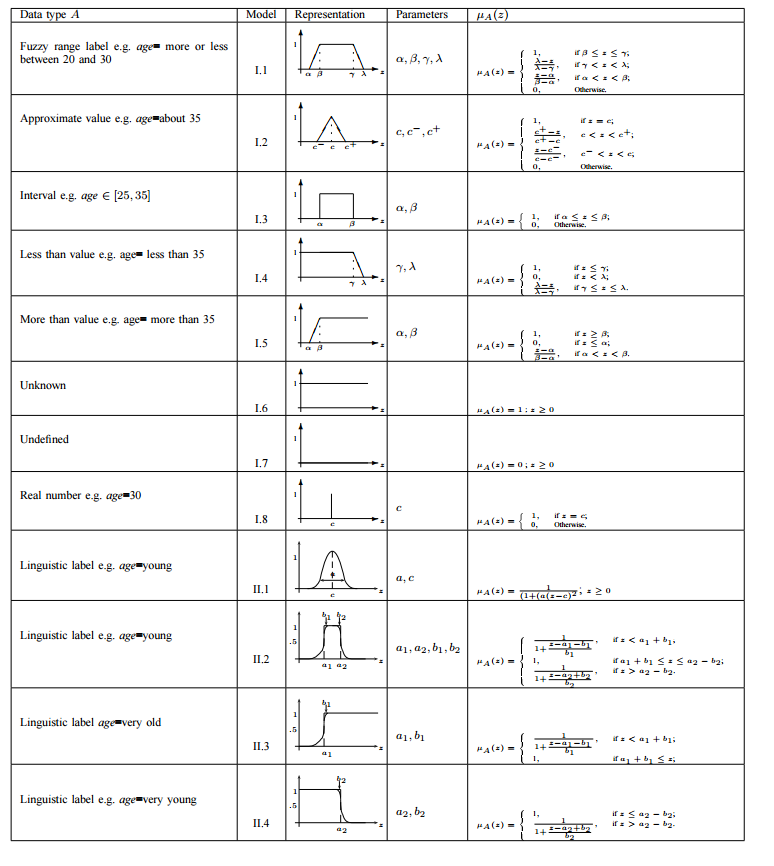
The heart of this research is to introduce a derive of fuzzy membership function which was the major drawback in the previous research. Different types of fuzzy membership functions were introduced as shown below.
We have covered other features such as data warehouse design, ETL and OLAP Cubes with fuzzy logic using a real-world dataset of 2.6 millions of records.
Multiple research papers were published as follows.
- PPG Dinesh Asanka, Amal Shehan Perera, Design Strategy for Fuzzy Data Warehouses, 2nd International Conference on Innovative Research in Science, Technology & Management, National University Singapore, 29-30 September 2018.
- PPG Dinesh Asanka, Amal Shehan Perera, Defining Fuzzy Membership Function for Fuzzy Data Warehouses, 4th I2CT IEEE Conference, SDMIT Ujire, Mangalore, India, October 2018.
- PPG Dinesh Asanka, Amal Shehan Perera, Linguistic Analytics in Data Warehouses Using Fuzzy Techniques, IEEE International Research Conference on Smart Computing and Systems Engineering – 20019, Department of Industrial Management, University of Kelaniya, 28th Match 2019.
- PPG Dinesh Asanka, Amal Shehan Perera, Feasibility of Fuzzy Data Warehouse, International Journal of Research in Computer Applications and Robotics, ISSN 2320-7345, Vol. 5 Issue 11, November 2017.
- PPG Dinesh Asanka, Amal Shehan Perera, Defining Fuzzy Membership Function Using Box Plot, International Journal of Research in Computer Applications and Robotics, ISSN 2320-7345, Vol. 5 Issue 9, September 2017.